Download Modelling in Life Insurance – A Management Perspective (EAA Series) - Jean-Paul Laurent | ePub
Related searches:
At the end of the day, the steps in the actuarial process from the original days of the life table haven’t changed. We still need to collect data, build models, develop products and monitor the results; within our professional framework. However, with the insurance environment becoming more complicated, the demand is growing for advanced solutions with features to unlock new opportunities and allow actuaries who embrace the digital advancements to do more in less time.
Looking for peace of mind? having the right life insurance policy can go a long way to giving you the comfort of knowing that your loved ones will be cared for if the unthinkable happens.
I've been researching new actuarial models (as one does) for life insurance in order to better understand what's been done in the past and where we are going.
Predictive modeling has been gaining attention in the life insurance industry for its potential to enable life insurers to use consumer data to augment aps and blood testing in assessing mortality risk. However, it’s less recognized that predictive modeling has many other application potentials that can deliver immediate benefits to life insurers.
In the market for a new (to you) used car? it’s no secret that some cars hold their value over the years better than others, but that higher price tag doesn’t always translate to better value under the hood.
With contributions from internationally renowned academics in actuarial science, finance, and management science and key people in major life insurance and reinsurance companies, there is expert coverage of a wide range of topics, for example: models in life insurance and their roles in decision making; an account of the contemporary history of insurance and life insurance mathematics; choice, calibration, and evaluation of models; documentation and quality checks of data; new insurance.
Cyril and methodius in trnava actuarial modeling of life insurance using decrement models 1 iveta dirgova luptakova and maria bilikova abstract the aim of this paper is to elucidate decrement models and their use in actuarial calculations in life insurance. The first part deals with the most often used decrement model, the mortality table.
While some may think having to pay for insurance every month is dollar bills down the drain, if an incident occurs and you don’t have insurance, it can lead to major financial hurdles that may last for years to come.
With predictive analytics and data science assuming ever-expanding roles in insurance risk modeling, carriers would be well-served to establish practices that mitigate the creation of faulty models. Overfitting, the process of deriving overly optimistic model results based on particular characteristics of a given sample, is of particular concern for insurers.
Predictive modeling is being used to align marketing, distribution channels, products and services with customer requirements/preferences in order to improve hit ratio, customer engagement and retention by insurers. Key to realizing the business benefits of predictive modeling in the insurance sector is its successful implementation. In the report titled “predictive modeling for life insurance”, the deloitte team describes how predictive modeling techniques can be used to improve.
Increasingly it appears that models will be used for life insurance company financial reporting, so the asb and its life committee believe it is appropriate to set a standard for actuarial modeling, at least in certain high importance and reliance situations, such as where the results of the model directly enter the financial report or are relied upon by at least one party in a merger, acquisition, securitization or other financial transaction.
Use of predictive models is becoming more common throughout the business landscape. Underwriters need to understand the basic concepts as these models impact pricing, marketing and underwriting of life insurance products.
Many younger life insurance applicants engage in risky hobbies, such as skydiving, bungee jumping, scuba diving, and hang gliding. But identifying these individuals and their risky avocations can be a major challenge.
Now that you understand the benefits of selling life insurance, let’s discuss which life insurance jobs pay the best. Most agents learning how to sell life insurance decide to “niche” in a certain life insurance market.
A dividend discount model based on a minimum solvency ratio, and a net asset value (nav) model. After this 3-statement model, you’ll get an overview of embedded value, which is a key valuation methodology specific to life insurance.
Modelling in life insurance – a management perspective (eaa series) - kindle edition by laurent, jean-paul, norberg, ragnar, planchet, frédéric. Download it once and read it on your kindle device, pc, phones or tablets.
Modeling frees predictive modeling two-part models multivariate regression multivariate two-part model gini index meps validation concluding remarks predictive modeling predictive analytics is an area of statistical analysis that deals with extracting information from data and using it to predict future trends and behavior patterns.
Automation of the analysis of all these new sources of data via ai tools lays the groundwork for true claims transformation.
We use tyche to build individual life insurance models, and deliver an end-to- end modelling workflow.
It would be very helpful if some one can give me an example excel model of life insurance company.
Keywords: insurance, actuarial mathematics, risk, claim, individual risk model, collective risk the key problem was the determination of life insurance tariffs.
Make a prediction) individually for each policy or proposal when the defined event occurs. For example, a model that runs at the start of every month and makes renewal prediction for all policies falling due within 90 days from prediction date.
Jul 20, 2020 mortality modeling is a practice that is gaining popularity among life insurers and annuity providers.
For these calculations, you want to simplify the assumptions for the life insurance model to eliminate the noise and make it easier to replicate. Your term life insurance model works under the following assumptions: term life insurance contracts have fixed durations.
Ally deals with the price-making mechanisms in non-life insurance through the glm regression models — generalized linear model, more precisely the poisson.
The prophet variable annuity modules model many different types of guaranteed benefits typically found around the world in variable annuity products.
A review of current practices in asset liability management for annuities and life insurance, with perspectives on how us insurers can adapt to changing measurement frameworks.
Jun 25, 2019 the essential insurance model involves pooling risk from individual payers and redistributing it across a larger portfolio.
The standard modelis the model prescribed by the solvency ii directive. A surrenderis a terminated policy, like a lapse, but when there is still a cash refund. A termination is the cancellation of a life insurance policy by either the policyholder or the insurance company.
Having insurance can protect you and your family from surprises that could make you broke.
As an employee you can have a variety of insurances through your employer, one of them being life insurance covering death due to non-occupational illnesses.
Research projects – life insurance traditionally predictive modeling techniques have been used within the insurance industry to help gain a better understanding of current and/or future insured risks leading to improved risk segmentation and underwriting, pricing and marketing processes and decisions.
In the life insurance world it is pushed to the utmost complexity, requiring exacting work and long term collaboration of many skilled.
The model is based on a two-factor stochastic capital market model, supports the most important product characteristics, and incorporates a reserve-dependent bonus declaration. Furthermore, a first approach to en-dogenously model customer transitions is proposed, where realized policy returns are used for assigning transition probabilities.
Term life insurance is cheap because it’s temporary and has no cash value; in most cases, your family won’t receive a payout because you’ll live to the end of the term.
We first discuss underlying drivers of policyholder behavior in theory and survey the implica- tions of different models.
The book provides a sound mathematical base for life insurance mathematics and applies the underlying concepts to concrete examples. Moreover the models presented make it possible to model life insurance policies by means of markov chains.
In this presentation, we demonstrate msii and share our experiences working with fennia life, a finnish insurance company that successfully ran an authority.
Approaches to model stochastic mortality (see for example ballotta and habermann, 2006) and overall risk profile of life insurance, taking into account surrender risk and characteristics of italian life insurance market, as shown in savelli (1993), de felice and moriconi (2002) and olivieri and pitacco (2005).
Life insurance companies are competitive and can be intimidating to new clients. It's important to have your facts together before determining the company and the policy. Do your homework and check out these 10 great life insurance options.
Models in which the point of prediction is coincident with an event in the policy lifecycle. For example, prediction at proposal submission, prediction at policy issuance or prediction at the completion of 1 year from issuance.
This suggests that it to a certain degree is possible to predict the renewal probability of non-life insurance.
We modeled an eight-level ordinal life insurance-risk response on a parsimony led us to choose a 13-predictor logistic regression model from a pool of nine.
Models are useful in revealing claim-sensitive information to insurance compa-nies and giving insight into decisions on required premium levels, premium loading reserves and assessing the profitability of insurance products. The main components of aggregate claims of a non-life insurance company are frequen-cy/count and size/severity.
Willis re's actuarial and financial modeling team pairs technical proficiency with practical business sense. We help insurers quantify the financial impacts of risk – and then go one step further, setting the bringing our client.
In the report titled “predictive modeling for life insurance”, the deloitte team describes how predictive modeling techniques can be used to improve decision making processes in the areas of underwriting and marketing, resulting in more profitable and efficient operations.
Sep 5, 2019 under the solvency ii regime, life insurance companies are asked to derive their solvency capital requirements from the full loss distributions over.
This business data model (bdm) example explains how agreementscan be modeled over their lifecycle. A customer, john, is lookingfor a quotation for life insurance and is made an offer.
Life insurance and pension products are modeled by identifying states in a markov model (of the life of the insured), by attaching payment intensities to the states, and by attaching lump-sum payments to the transitions.
Simulation modeling on life care annuity: final report long-term care insurance research brief assessing the out-of-pocket affordability of long-term services and supports research brief later-life household wealth before and after disability onset report to the secretary on private financing of long-term care for the elderly.
In the life insurance business, an application of the least-squares monte carlo (lsmc) method offers a possibility to overcome this computational challenge. We outline in detail the challenges a life insurer faces, the theoretical basis of the lsmc method and the necessary steps on the way to a reliable proxy modeling in the life insurance business.
The life insurance disclosures model regulation makes clear that the delivery of the policy summary by the insurer shall be consistent with the time for delivery of the buyer’s guide and that the buyer’s guide must be provided to all prospective purchasers.
Life insurance is both a large industry and the most valuable method for individuals to financially protect their loved ones upon death. In 2011, households paid over $101 billion in premiums for life insurance policies bought directly from.
Supporting the pricing of life insurance and annuity products typically requires developing a model to apply expected future experience to measure the risks inherent in the product design and the likely future profit.
Life contingency models are models that deal with the payments (or bene ts) to a policyholder that are contingent on the continued survival (or death) of the person. The theory of insurance can be viewed as the theory of contingent payments.
Use of predictive models is becoming more common throughout the business landscape. Underwriters need to understand the basic concepts as these models impact pricing, marketing and underwriting of life insurance products. This primer introduces and describes predictive modeling, the development of predictive models, types of models, advantages and disadvantages of such models, and closes with a glossary of terms commonly encountered when discussing models with other professionals in your.
Drafting note: it is the position of the drafters of this regulation that universal life insurance is simply another competing type of life insurance which should be treated, to the extent possible, in the same regulatory manner as other life insurance products.
There exist numerous mathematical models of insurance company activity; main models are collective risk model and individual risk model. The traditional tasks of actuarial mathematics are evaluation of insurance.
The goals are to investigate how the canadian life insurance industry is utilizing predictive modelling and examine potential areas for enhancement. As a result, this study will focus on providing insights into applications used in the canadian life insurance industry compared to those of other industries and will.
Formula to simplify the life-insurance application process in order to encourage more customers to apply and, therefore, purchase life insurance. Comparison of ases, misclassification rates, lift, and relative parsimony led us to choose a 13-predictor logistic regression model from a pool of nine candidates.
The actual execution of the job of a life insurance agent can be disheartening, at least at the start.
Insurance providers are accelerating investment in digitization and closing gaps in business continuity models.
Cash flows of life insurance portfolios, annuity portfolios, and portfolios of mortality derivatives. We show how to apply the model to analyze and price a longevity.
Variable life insurance is a form of life insurance that combines the characteristics of life insurance and investment. Similar to any life insurance policy, variable life insurance provides a death benefit and requires the beneficiary to pay premiums into an account.
Nov 20, 2019 you might be running a cash flow test of a life insurance product, and the model “ output” indicates that across 95% of your stochastic scenarios,.
April 13, 2018 / reinsurance� insurtech� artificial intelligence� life underwriting� machine learning. Machine learning and artificial intelligence are hot topics right now – and for good reason. Machine learning (ml) and artificial intelligence (ai) are unlocking new insights, capabilities, efficiencies, and opportunities across industries and sectors.
Machine learning in least-squares monte carlo proxy modeling of life insurance companies.
This paper wants to give an overview of relevant distributional models and diagnostics to model large claims or outliers in an insurance setting. The specific behaviour of portfolio items such as total claim amount and ruin probabilities, and the problem of reinsurance in the presence of large claims, are elucidated.
The life insurance industry model set consists of enterprise, business area, and data warehouse logical data models developed for companies providing insurance products and services to the life and annuity insurance industry.
A stochastic model would be to set up a projection model which looks at a single policy, an entire portfolio or an entire company. But rather than setting investment returns according to their most likely estimate, for example, the model uses random variations to look at what investment conditions might be like.
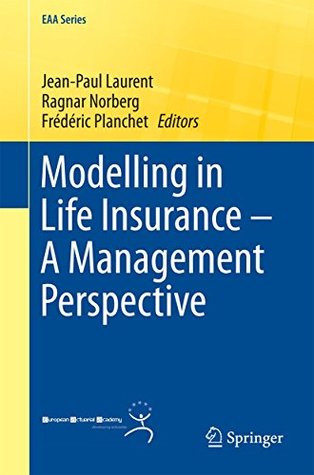
Explores a broad range of aspects of modelling in modern life insurance. Provides views and objectives of the top management of insurance companies. Examines modelling activities within the context of consumer needs, the public interest and business objectives. Focusing on life insurance and pensions, this book addresses various aspects of modelling in modern insurance: insurance liabilities; asset-liability management; securitization, hedging, and investment strategies.
Jun 12, 2020 in our january 2020 us agent survey, about 90 percent of life insurance agents' sales conversations and nearly 70 percent of their ongoing.
In this paper, models for claim frequency and average claim size in non-life insurance are considered.
People are often excited when they receive dental insurance from their jobs. They're excited, that is, until they realize that dental insurance is not like medical insurance.
Learn about milliman services for helping insurers maintain adequate life insurance risks: observations on solvency ii and the modeling of capital needs.
Insurance and annuity products covering several lives require the modelling of the joint distribution of future lifetimes. Commonly in actuarial practice, the future lifetimes among a group of people are assumed to be independent. This simplifying assumption is not supported by real insurance data as demonstrated by numerous investigations.
Stochastic modeling is on the rise in the life insurance industry due to a coalescence of regulations on the horizon and an increasing demand for stochastic analysis in many internal modeling exercises.
Explores a broad range of aspects of modelling in modern life insurance provides views and objectives of the top management of insurance companies examines modelling activities within the context of consumer needs, the public interest and business objectives.
Data-science statistics insurance risk-analysis random-forest statistical-learning p-value statistical-analysis risk-models risk-assessment data-mining-algorithms statistical-data statistical-models life-insurance risk-modelling risk-calculations backward-elimination multiple-linear-regression alpha-value kaggle-life-insurance.
It is possible to model life contingency insurances with the lifecontingencies r pack-age, which is capable of performing financial and actuarial mathematics calculations. Its functions permit one to determine both the expected value and the stochastic distribu-tion of insured benefits. Therefore, life insurance coverage can be priced and portfolios.
Focussing on life insurance and pensions, this book addresses various aspects of modelling in modern insurance: insurance liabilities; asset-liability management; securitization, hedging, and investment strategies. With contributions from internationally renowned academics in actuarial science, finance, and management science and key people in major life insurance and reinsurance companies, there is expert coverage of a wide range of topics, for example: models in life insurance and their.
Life insurance is something we all hope we won’t need, but as we know, life is unpredictable. In this article, we’ll focus on formulating a data model that a life insurance company may use to store its information.
Model and leverage it as a competitive advantage, every insurer will need to understand where it is in the path to fod and make investments in new distribution capabilities to stay ahead of market requirements.
Post Your Comments: