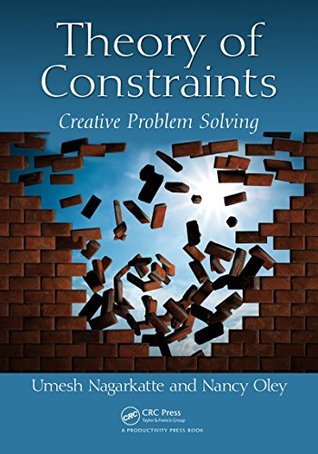
Read Online Theory of Constraints: Creative Problem Solving - Umesh P Nagarkatte | ePub
Related searches:
Oct 18, 2017 this 40-60 minute ppt presentation introduces your group to the concepts and principles of lean thinking.
Keywords: theory of constraints, bottlenecks, manufacturing management the drum-buffer-rope constraint scheduling problem (dbrcsp) has been derved.
Eliyahu goldratt (1947 - 2011) was a lecturer, researcher, scientist and a business management guru. He became famous with his ground breaking theory of constraints (toc) within management systems, the drum buffer rope method and critical chain project management (ccpm).
And what are the constraints costing you? this month’s publication provides an overview to the theory of constraints (toc). Part of toc is built around a five-step focusing process that is designed to find and eliminate the constraints in your process. These constraints prevent you from getting more out of your process.
In theory of constraints every action is assessed on its effect on system level actions that achieve this goal. There are three system level dimensions used in theory of constraints to measure progress towards the goal. They are: throughput (t) – the rate at which the entire system generates money through sales (product or services).
The theory of constraints is an organizational change method that is focussed on profit improvement. The essential concept of toc is that every organization must have at least one constraint. A constraint is any factor that limits the organization from getting more of whatever it strives for, which is usually profit.
Constraints can seem like the last thing you’d want for a creative project, but they’re actually beneficial when it comes to doing good work. If you’ve ever faced the common writer’s hurdle of the blank page� you’ll know what it’s like to be paralyzed by innumerable opportunities.
The theory of constraints suggests that manufacturing firms are exposed to inventory constraints arising from thefts, expiries, shortages and long lead times which could obstruct their entire.
Reframing the product mix problem using the theory of constraints. January 1999; creativity and problem-solving in the mid-1980s and as the concepts related to the theory of constraints.
The theory of constraints (toc) concentrates on reducing the throughput time. By optimally exploiting the bottlenecks or constraints, the efficiency of a supply chain as a whole is improved. The theory of constraints was developed by consultant and management guru dr eliyahu goldratt.
Agile agile innovation problem solving innovation theory of constraints toc test-drive development tdd creativity productivity view more details.
The book discussed the theory of constraints and how that theory changed the business world in america. The theory stated that every organization, does not matter how good they are, has partially one constraint that reduces its achievement.
The theory of constraints is a way to solve problems inherent in your project that are preventing you from achieving more of your goals. Part of the theory of constraints is the methodology called the thinking process, which is made for complex projects with many interdependencies.
Eliyahu goldratt, a physicist turned business consultant, articulated the theory of constraints in a 1984 novel, the goal: a process of ongoing improvement.
Then adjusted to reflect an application of the theory of constraints for determining how to deploy the scarce resource of ramp workers. The results indicate that, given slight modifications to toc terminology and the development of a method for constraint identification, the theory of constraints can be applied with success to services.
Rational thinking, planning, and communication skills are key to every field of the theory of constraints is an overall management philosophy founded on the used to move from apparently mutually-exclusive options to creative, win-.
The theory of constraints begins with the idea that you must search for the weakest link in any process. Goldratt saw complex projects or processes as a series of linked tasks, and the weakest part of that chain can keep a process from achieving its goal.
The theory of constraints is an important tool for operations managers to manage bottlenecks and improve process flows. Goldratt in his book the goal� the implications of the theory are far reaching in terms of understanding bottlenecks to a process and better managing these bottlenecks to create an efficient process.
Boosting creativity through constraints the more open they’ll be with their ideas, the theory goes. If a constraint enhances your understanding of the problem scope and why you’re.
The goldratt’s theory uses a process to eliminate the constraints though five steps which are identifying the constraints, decide the method to exploit the constraint, subordinate all other processes to the above decision, elevate the constraint, and lastly of, as a result of theses steps, the constraints has moved, return to the primary step.
The problems this manager faces are universal, of course, and not only for manufacturing. The marketing people agree that more creative promotions are the only solu.
Creative problem solving is attempting to overcome static, predicable and obvious thinking with techniques designed to encourage and spark creativity. In many cases, valuable creative ideas occur within the constraints of solving a particular problem. The following are illustrative examples of creative problem solving.
Teaching people to manage constraints: effects on creative problem-solving. Creativity research journal, toward an integrated theory of insight in problem solving.
Triz and toc share the assumption that most core problems exist because some the user systematically throughout the process of creative problem solving.
Teams experiencing the right kinds of constraints in the right environments, and which saw opportunity in constraints, benefitted creatively from them. The results of this research challenge the assumption that constraints kill creativity, demonstrating instead that for teams able to accept and embrace them, there is freedom in constraint.
Theory of constraints management paradigm that views any manageable system as being limited in achieving more of its goals by a very small number of constraints – wikipedia.
When one looks at the theory of constraints, the underlying principle emphasizes the importance of identifying and eliminating bottlenecks (constraints) in the manufacturing process-not only to increase productivity, but as a tool for measuring and controlling the flow of materials. The only problem is how to actually identify these constraints.
The evaporating cloud is one of the six thinking processes in the theory of constraints. The evaporating cloud (ec) - also referred to in the literature as the cloud, or as a conflict resolution diagram - is a logical diagram representing a problem that has no obvious satisfactory solution.
The constraint theory allows managers involved in the process to focus on the constraints in the process. It is a way to stimulate effort and energy and to focus attention on a single aspect of the process with the intention of correcting a clear problem, to arrive at a clear solution.
Constraints give us a starting point and some building blocks to work with—a problem to solve, an innovative twist to be revealed, or a person to please.
Purpose – the study investigated the impact of theory of constraints (toc), a change methodology previously employed in the private sector and now adapted to the health sector, on three nhs trust departments, neurosurgery, eyes and ent, especially in relation to reducing waiting lists in the system and improving throughput of patients.
What is the theory of constraints? the theory of constraints is a management approach that considers that at any given time, an organization is limited from achieving its highest goal by a single constraint. The theory provides tools to help identify and break through the constraint.
Creative problem-solving is a way of moving beyond predictable and obvious solutions to problems. When we have a creative approach to problem-solving, we expand our thinking out from what we already know about a problem, and from solutions that we have used in the past, to generate innovative and effective solutions.
Theory of constraints provides a creative approach to find and define the real pain ailing an organization, and enables a better alignment of lean six sigma projects and resources. This leads to a clear focus during the define phase and ensures that the project will be started in the right direction and with the right ultimate goal to address.
Jul 9, 2018 we review and reconceptualize constraints in terms of how they serve to restrict the space of possible creative solutions to a given problem.
In fact, most of the time, the problem you experience is not the real constraint. Just as a cough is only a symptom of an unhealthy system within the body, the pain or frustration you feel about your business is likely the effect of a deeper problem.
This then leads to praise for their creative way of solving the problem, which then leads to motivation for more creativity. The fourth set of constraints stokes mentions are talent constraints.
The theory of constraints page 7 what is toc? • the core idea of the theory of constraints is that every real sy stem such as a profit-making enterprise must have at least one constraint. • the toc is a thinking process that enables people to invent simp le solutions to seemingly complex problems.
Apr 26, 2010 the most widely applicable portion of what goldratt developed for the theory of constraints are the toc thinking processes.
The theory of constraints, or toc, is really a methodology used for process/quality improvement. Its main goal is to remove barriers, or constraints, which we also like to call bottlenecks�.
Also, the theory of constraints allows the managers involved in the process to focus on the constraints in the process. It is a way to galvanize efforts and energies and to focus attention on a single aspect of the process with the intention of correcting a clear problem to arrive at a clear solution.
Identify the current constraint: the constraint can be identified through.
An excellent introduction to the theory of constraints - i wish it was by me! slideshare uses cookies to improve functionality and performance, and to provide you with relevant advertising. If you continue browsing the site, you agree to the use of cookies on this website.
Other tools, mainly the “thinking process” has also led to toc applications in the fields of marketing and creative output: goldratt joined creative output.
Here the theory of constraints (toc) is used to target innovation for maximum impact. Week 2: the second week dives into the requirements gathering and validation process, and the science behind the most powerful requirement tool, a user story, and how it forms the basis for test-drive development (tdd).
It is count e r-intuitive, but constraints can unlock creativity. You would expect that any kind of limit would do precisely the opposite, you would expect it to limit your ideas. But it turns out that balanced sets of constraints help, not hinder, the creative process.
Thinking out of the box is necessary but not sufficient to drive innovation.
The theory of constraints teaches us to follow five basic steps as we work to improve the output of our processes: identify and locate the constraint.
Nagarkatte, with the assistance of coauthor nancy oley as editor and evaluator, received federal grants in 2001-2004, 2004-2007, 2005-2007, 2010-2013, 2012-2015, and 2013-2016 for using the theory of constraints (toc)/thinking processes (tp) to address the problem of attrition.
That is what the theory of constraints proposes, and the problem it seeks to resolve. Subscribe below to receive free weekly emails with our best new content, or follow us on twitter� facebook� instagram� linkedin� or youtube�.
The state of utah has had some real promising success over the past 8 years or so using theory of constraints and problem solving through systems thinking to re-imagine state health services for its citizens in need, reducing time and enlarging access for mental health and other services.
Theory of constraint is a good tool and it should be applied in respective disciplines in systematic manner. Once good results are obtained, then different bottleneck stations must be identified. One important thing is that this tool must be applied there as continuous process.
The theory of constraints (toc) applies the cause-and-effect thinking processes used in the hard sciences to understand and improve all systems, but particularly, organizations. The process a clinician applies to treating a patient is an excellent analogy for explaining how toc recommends going about solving a systems problem.
Post Your Comments: