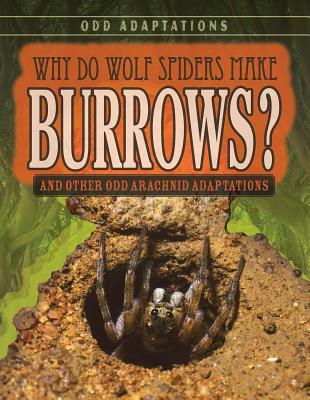
Read Online Why Do Wolf Spiders Make Burrows?: And Other Odd Arachnid Adaptations - Meghan Sharif | ePub
Related searches:
Why did my wolf spider make a burrow that is completely encased in dirt and webbing? i think it is a wolf spider. It has stoped eating for the last couple of days and then it started to make the burrow for what i thought would be a trap to catch insects but its completely covered.
Some wolf spiders spend all of their lives above ground (taking the best shelter they can find), others dig burrows but come out of the burrows to wander about and hunt, and some spend almost all of their lives waiting for passing insects in their burrows. One species of wolf spider gives us the name that is now used in english for an entirely.
Wolf spiders have the ability to produce silk, but they usually only use it to wrap their egg sacs. Can spiders see? some spiders, like jumping spiders and wolf.
The young spiders are spread randomly which is why wolf spiders occupy a wide range of habitats. They often live in cotton fields, buildings, wooded areas, under rocks, rubbish, holes, on low foliage in these regions.
A female wolf spider carries her egg sac through the underbrush. (image credit: mccarthy's photoworks shutterstock) appearance. Wolf spiders are usually brown, grey, black or tan, with dark.
Wolf spider burrows because wolf spiders are active hunters, their dwelling habits differ from other species of spiders. While they are still able to spin webs, many species of wolf spiders live in shallow burrows or tunnels that they dig into the dirt. A wolf spider's burrow is used for resting, and to overwinter.
During rainy seasons, the spiders create room and hide within the burrows.
Why do i have a wolf spider problem? wolf spiders are generally found outside hiding under rocks, landscaping timbers, leaf piles, woodpiles, and other similar areas. They sometimes make their way inside of homes, garages, and sheds as they are hunting for food.
Ground-dwelling insects and other spiders make up the bulk of their diet. Wolf spiders, with their excellent vision and excellent running abilities, chase down and grab their prey. Also, they can hold still and wait for insects to crawl near enough to catch.
Wolf spiders spin webs, but only as a protective measure, not as a habitat. Rather, wolf spiders live in natural hollows or those that they create. Most wolf spiders live in holes in the ground and spin webs over the entrances of these holes to protect them when they sleep.
Some species of wolf spiders dig holes for protection while they sleep.
It isn’t uncommon for them to dig deep burrows where they will spend lots of time. They are very intelligent and may put a trap door on that burrow. They use pebbles to block holes too so that they don’t get any rain in their burrow.
Wolf spiders may burrow into a lawn, leaving silken webs to capture insects. They also may wait in silken retreats beneath logs and rocks for prey.
Some burrowing spiders prefer to wait for unsuspecting prey -- from the comfort of their burrows -- at night. Tarantulas are nocturnal creatures and are part of this category. Burrowing wolf spiders, on the other hand, tend to be diurnal.
Wolf spiders typically live in burrows underground, with the flood waters forcing them out of their secret homes and into the open. An hour south of ms williams’ macksville home, more spiders were fleeing the flooded kinchela creek. Kinchela, a village on the mid-north coast of nsw, sits near the macleay river.
Some wolf spiders will live in and defend burrows while others may roam around looking for food. Like many spiders, wolf spiders tend to avoid people but will live in and around basements, lofts.
This is why the eyes of dogs, cats, and yes, wolf spiders seem to glow when you shine a light on them, he explains. And speaking of eyes, wolf spiders have eight of them—two rows of four eyes.
Mating for wolf spiders is a dangerous affair because males are sometimes killed and consumed by females following mating.
Astounding facts about wolf spiders that’ll leave you awestruck. We tend to associate spiders with their ability to build a web to catch prey, but there exists an entire family of spiders which does not resort to this technique. As you go through some interesting wolf spider facts, you will get an entirely new perspective about these arthropods.
(a few spiders do make soil burrows, but soil is a rather different and more forgiving medium). Spiders have fangs, which are thin and sharp and can appear scary, but if you’ve ever tried to dig a hole using only hypodermic needles you’ll appreciate the uphill battle a spider.
The spiders will wait in their burrows until they sense vibrations in the ground caused by insects (including crickets, moths, beetles, and grasshoppers) and other spiders. Then, the spiders will leap out of the trapdoor, grab one of these animals, and drag it back into the burrow.
Wolf spiders do not spin a web, instead, they roam at night to hunt for food. Wolf spiders are often confused with the brown recluse spider, however, they lack the violin-shaped marking of the recluse. The wolf spider is shy and is most likely to run away when disturbed.
Wolf spiders typically live in burrows underground, with the flood waters forcing them out of their secret homes and into the open. An hour south of ms williams’ macksville home, more spiders.
They either make their own burrow or find and inhabit one already made. To construct their own burrow, the carolina wolf spider digs out a small area, spins a web to act as a mat that will hold the structure.
Mar 15, 2021 grass: wolf spiders are field spiders that hide in tall grasses and pounce on their prey, hence their name.
Wolf spiders resemble nursery web spiders (family pisauridae), but wolf spiders carry their egg sacs by attaching them to their spinnerets, while the pisauridae carry their egg sacs with their chelicerae and pedipalps. Two of the wolf spider's eight eyes are large and prominent, which.
Remember that the wolf spider is actually one of the good guys. When it comes to biting spiders though (even relatively harmless ones) most of us draw the line at the front door. To keep wolf spiders from stopping by, start by sealing any gaps around doors, windows or foundations.
Mechanics and energetics of excavation by burrowing wolf spiders, 12-30 mm ), that build a shallow burrow, which is sometimes covered with a flimsy.
Special behaviors of wolf spiders� wolf spiders have keen senses, which they use to hunt, find mates, and protect themselves from predators. They can see quite well and are highly sensitive to vibrations which alert them to movements of other organisms. Wolf spiders rely on camouflage to hide them in the leaf litter where they roam.
The four in a row can have two larger ones in the middle and two smaller ones outside, but regardless, there are four. So many eyes make for good hunting! wolf spider eyes (photo: flicker sharing, thomas shahan). Wolf spider (photo: flicker sharing, e_monk) describing wolf spiders is difficult because they have a wide range of colors and markings.
Wolf spiders do not spin webs and reside instead within burrows. In rainy seasons, wolf spiders plug their burrows with pebbles and build turrets to deflect floodwater.
And it’s understandable why—brown recluse spiders are one of the more dangerous spiders that you can find in the united states. But just because a brown recluse spider bites a human doesn’t mean they do so to feed, unlike other pests that bite such as mosquitoes.
There are wolf spiders that have specific habitat needs like gravel beds, herb fields, and specific type of temperature. There are wolf spiders that cover their nests with pebbles and leaves when the monsoon starts.
Post Your Comments: