Read Huygens' Principle and Hyperbolic Equations (Perspectives in Mathematics Book 5) - Gunther Paul | PDF
Related searches:
Huygens' principle and the modelling of propagation - IOPscience
Huygens' Principle and Hyperbolic Equations (Perspectives in Mathematics Book 5)
Finite Propagation Speed for First Order Systems and Huygens
A Huygens principle for diffusion and anomalous diffusion in - PNAS
Holographic principle and Huygens principle - Physics Stack
Huygens' Principle and Hyperbolic Equations ScienceDirect
Huygens' Principle and Hyperbolic Equations, Volume 5 - 1st
Amazon.com: Huygens' Principle and Hyperbolic Equations
Huygens' Principle and Hyperbolic Equations - Gunther Paul
FERMAT’S AND HUYGENS’ PRINCIPLES, AND HYPERBOLIC EQUATIONS
Huygens’ Principle for Hyperbolic Operators and Integrable
Huygens’ principle for hyperbolic operators and integrable
15. Wave equationpropagation of light and sound
Fermat's Principle and the Geometric Mechanics of Ray Optics
The Solution and Huygens' Principle for a Singular Cauchy - JSTOR
Multidimensional Baker-Akhiezer functions and Huygens' principle
(PDF) Huygens' principle for hyperbolic operators and
(PDF) Huygens' Principle for Hyperbolic Operators and
Ørsted : Review: Paul Günther, Huygens' principle and
(PDF) Fermat's and huygens' principles, and hyperbolic
Huygens' principle and integrable systems - NASA/ADS
Conformal Invariance, Huygens Principle and Fundamental
Huygens’ Principle and Integrability SpringerLink
Huygens' principle and the path integral INIS
waves - Holographic principle and Huygens principle - Physics
Huygen's Principle and Diffraction - YouTube
Waves and Huygens's Principle - Occidental College
Huygens' principle and equipartition of energy for the
Huygens Principle - Definition, Theory, Derivation and FAQs
Waves and Huygen’s Principle: x - Occidental College
Huygens’ principle and characteristic propagation property
Huygens' principle and integrability
Huygens' Principle and Diffraction of Waves - Science Grade
(ebook) Huygens' Principle and Hyperbolic Equations
A Deformed Wave Equation and Huygens' Principle
HUYGENS' PRINCIPLE AND SEPARATION OF VARIABLES Reviews in
(PDF) Lenses spherical and huygens Pavlos Mihas - Academia.edu
Huygen's Principle: Explanation, Videos and Solved Questions.
Huygens' Principle and Hyperbolic Equations by Gunther Paul
A Deformed Wave Equation and Huygens’ Principle
[solv-int/9704012] Huygens' Principle in Minkowski Spaces and
Huygens’ principle and equipartition of energy for the
Reflection and Refraction of Light Waves (Huygens' Principle)
A new class of linear second order hyperbolic partial differential operators satisfying huygens' principle in minkowski spaces is presented. The construction reveals a direct connection between huygens' principle and the theory of solitary wave solutions of the korteweg-de vries equation.
A review on huygens’ principle for linear hyperbolic differential operators. In proceedings of the international symposium group-theoretical methods in mechanics, novosibirsk, russia, 25–29.
Huygens' principle provides a convenient way to visualize refraction. If points on the wavefront at the boundary of a different medium serve as sources for the propagating light, one can see why the direction of the light propagation changes.
Mclenaghan, an explicit determination of the empty space-times on which the wave equation satisfies huygens' principle. Mclenaghan, on the validity of huygens' principle for second order partial differential equations with four independent variables.
Huygens’ principle, in optics, a statement that all points of a wave front of light in a vacuum or transparent medium may be regarded as new sources of wavelets that expand in every direction at a rate depending on their velocities. Proposed by the dutch mathematician, physicist, and astronomer,.
5 for a precise formulation) is violated by any linear, normal hyperbolic partial differential equation in which the solution depends on an odd number of variables. 5,6 when the number of variables is even, as in a four-dimensional space-time, huygens’ principle may or may not hold.
At the base of the hierarchy, you have a regular hyperbolic pde on the body without any super information entering into it, and it is only this equation that controls the speed of propagation and hence the huygens' principle. This approach was pioneered by choquet-bruhat in the seminal paper.
The huygens–fresnel principle (named after dutch physicist christiaan huygens and french physicist augustin-jean fresnel) is a method of analysis applied to problems of wave propagation both in the far-field limit and in near-field diffraction and also reflection.
Huygens principle is one of the key methods for studying various optical phenomena. The principle is a method of analysis applied to problems of wave propagation both in the far-field limit and in near-field diffraction and also reflection.
May 21, 2013 strongly chaotic systems include anosov flows [gallavotti–cohen chaotic hypothesis (29)] and uniformly hyperbolic (axiom a) attractors.
Actually the first lens that was studied mathematically was a hyperbolic lens which changes shape depending on the position of the source and the refractive index (rashed 1992, mihas 2008) huygens lens is the lens that was proposed by christian huygens (huygens 1690) as is a direct application of fermat’s principle.
Christiaan huygens frs (/ ˈ h aɪ ɡ ən z / hy-gənz, also us: / ˈ h ɔɪ ɡ ən z / hoy-gənz, dutch: [ˈkrɪstijaːn ˈɦœyɣə(n)s] (); latin: hugenius; 14 april 1629 – 8 july 1695), also spelled huyghens, was a dutch physicist, mathematician, astronomer and inventor, who is widely regarded as one of the greatest scientists of all time and a major figure in the scientific revolution.
There is no proper transformationlal mechanism that ensures this has been done correctly. Normans course on hyperbolic geometry goes into detail about this kind of set up, and it is not trivial, nor impossible. The additonal principle added by fresnel also needs to be examined closely.
Huygens' principle (hp) is understood as a universal principle governing not only the propagation of light. According to hadamard's rigorous definition, hp comprehends the principle of action-by-proximity (cf faraday's field theory etc) and the superposition of secondary wavelets (huygens' construction).
Huygens' principle for hyperbolic operators and integrable hierarchies.
Huygens was a polymath almost without equal, credited with discovering the rings of saturn, the moon titan, the invention of the pendulum clock and groundbreaking studies on optics and centrifugal forces, this study goes beyond these discoveries to find out more about the man and what made him strive to know more.
New results on group theoretical aspects of the huygens principle are presented. An extension of darboux-lagnese-stellmacher’s transformation to the wave equations in spaces with non-trivial conformai group is considered.
The huygens–fresnel principle is a method of analysis applied to problems of wave propagation both in the far-field limit and in near-field diffraction and also reflection. It states that every point on a wavefront is itself the source of spherical wavelets, and the secondary wavelets emanating from different points mutually interfere. Wave refraction in the manner of huygens wave diffraction in the manner of huygens and fresnel.
Huygens principle is also known as the huygens–fresnel principle. This principle was named after dutch physicist christiaan huygens and french physicist augustin-jean fresnel. It is a method of analysis that applies to problems of wave propagation both in the near-field and far-field limit and in near-field diffraction and also in reflection.
Huygen’s principle also sometimes called as huygens–fresnel principle states that each point on a given wavefront is a source of secondary wavelets or secondary disturbances. Further, the disturbances originating from the secondary source spreads in all directions in the same way as originating from the primary source.
Accordingly the wave equation (1) is said to satisfy huygens's principle if and huygens's principle in a hyperbolic space with an odd number ofdimensions.
The term huygens' principle, however, was not clear until its precise mathemat- icd meaning, within the context of the theory of hyperbolic partial differentid.
Huygens' principle can be seen as a consequence of the homogeneity of space—space is uniform in all locations. Any disturbance created in a sufficiently small region of homogenous space (or in a homogenous medium) propagates from that region in all geodesic directions.
Huygens’ principle embodies a simple but powerful physical concept that serves to explain in a lucid manner how an arbitrary wavefront progresses from one point to another (robinson and clark, 2006b). According to this hypothesis, each individual point on an advancing wavefront is disturbed.
Huygens' principle and hyperbolic equations (perspectives in mathematics) by paul gunther (author) isbn-13: 978-0123073303.
It is a well known fact that the wave operator possesses huygens' principle for odd n greater than or equal to 3 and does not posses it otherwise. Hadamard's problem consists in classifying all second order hyperbolic operators which obey huygens' principle, up to trivial relations.
Jan 12, 2009 thus, analogously to the solution of total-hyperbolic differential equations [28], one may define also within optics and for general propagation.
The mathematical huygens principle is expressed in terms of cauchys initial value problem to a given hyperbolic differential equation. Huygens principle is satisfied if the solution of such a problem taken in a point x depends only on the cauchy data (and their.
Huygens' principle (hp) is understood as a universal principle governing not only günther p 1988 huygens' principle and hyperbolic equations (new york:.
For 2 space dimensions, however, or for relativistic particles with a non-vanishing mass, and for hyperbolic partial differential equations in general, one gets only the weak form of huygens' principle where the amplitude is propagated both on and inside the light cone.
Describe all second-order hyperbolic equations for which huygens' principle holds. From the results of hadamard it follows that huygens' principle can hold only in the case of an odd number of dimensions. For a long time it was thought that all such equations can be reduced to the usual wave equation using the following transformations, called elementary:.
Being hyperbolic, the wave equation has nite speed of propagation for all informationnamely 1, a curious property known as huygens' principle is as follows.
Classes: those for which the huygens' principle holds (that is, there are no after effects) and the let l be a linear partial differential operator of hyperbolic type.
A review on huygens’ principle for linear hyperbolic differential operators. In proceedings of the international symposium group-theoretical methods in mechanics, novosibirsk, russia, 25–29 august 1978.
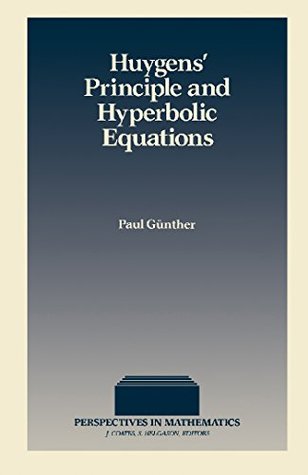
Huygens' principle and hyperbolic equations is devoted to certain mathematical aspects of wave propagation in curved space-times. The book aims to present special nontrivial huygens' operators and to describe their individual properties and to characterize these examples of huygens' operators within certain more or less comprehensive classes of general hyperbolic operators.
0) of a hyperbolic pde is the subset of the initial conditions which uniquely determine the value u(x 0, t 0):1 huygens’s principle tells us that for n-odd, we can evaluate the function at a point (x 0,t 0) by integrating over the boundary of the domain of dependence.
Geometry and partial differential equations his work on 2nd order hyperbolic equations in relation to huygens principle stands out as particularly significant.
Satisfies huygens' principle in the sense of hadamard's minor premise.
The theory of integrable systems, in particular of the generalised calogero-moser problem, is applied to constructing and investigating examples of the hyperbolic equations satisfying huygens' principle in hadamard's sense.
The physical notion of huygens’principle goes back to the classical “traité de la lumière” by christian huygens, published in 1690. Various aspects of this fundamental principle in the theory of wave propagation were later discussed in the works of kirchhof, poisson, beltrami and other scientists.
Feb 15, 2006 this theory is applied to the famous hadamard problem of description of all hyperbolic equations satisfying huygens' principle.
We demonstrate a close relation between the algebraic structure of the (local) group of conformal transformations on a smooth lorentzian manifold and the existence of nontrivial hierarchies of wave-type hyperbolic operators satisfying huygens' principle on� the mechanism of such a relation is provided through a local separation of variables.
Sep 7, 2018 namely the field of linear wave propagation (in the language of mathematics, linear hyperbolic pdes of second order).
Huygens’s concept of secondary wave is a geometrical method to find the wavelength. Huygen’s principle states that every point on the wavefront may be considered a source of secondary spherical wavelets which spread out in the forward direction at the speed of light.
The dutch scientist christiaan huygens (1629–1695) developed a useful technique for determining in detail how and where waves propagate. Starting from some known position, huygens’s principle states that every point on a wave front is a source of wavelets that spread out in the forward direction at the same speed as the wave itself.
Huygens’ principle for dirac operators 485 it is a well known fact that the wave operator possesses huygens’ principle for odd ngreater than or equal to 3 and does not posses it otherwise. Hadamard’s problem consists in classifying all second order hyperbolic operators which obey huygens’ principle, up to trivial.
Huygens’ principle for hyperbolic operators and integrable hierarchies. We show that the stationary solutions of the canonical akns hierarchy of nonlinear evolution equations yield perturbations of dirac operators that satisfy a strict form of huygens’ principle.
As an application, we present a new approach to the weak huygens' principle for second order hyperbolic equations.
Fermat's and huygens' principles, and hyperbolic equations and their equivalence in wavefront construction september 2013 neural, parallel and scientific computations 21(3):305-318.
We show that the huygens’ principle and the equipartition of energy hold if the inverse of the harish-chandra c-function is a polynomial and that these two properties hold asymptotically otherwise. Similar results were established previously by branson, olafsson and schlichtkrull in the case of noncompact symmetric spaces.
Post Your Comments: